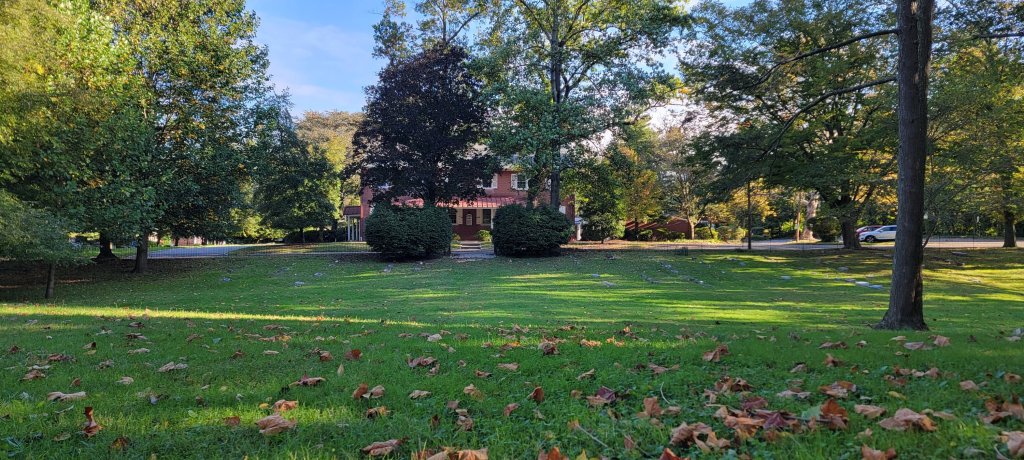
You Belong Haddonfield Friends Meetinghouse from the graveyard
I received this message this morning from someone dear to me: “Dee, you certainly belong in this family. We have all been through many fires and have all been Triumphant.” sometime after I was done crying I began to think about the difference between “belonging in”, and “belonging to”; between chattel and partnership, between “one among” and “one of”.
Growing up, I always felt a if I were trying to be, but never succeeding at being “one of”. Not in my family, not in my church, not at school, not by many in the military in which I was compelled to enlist after high school, not even in my own body. My family and my church were constantly telling me that I wasn’t who I knew myself to be, and I was punished, often harshly, for stepping outside the bounds of what was considered acceptable.
We learn who we are when we are accepted, when we discover a sense of belonging with those who love and accept us as we are. We become better versions of ourselves among those with whom we belong when they challenge us to do better, not because they dislike us, or because we embarrass them, but because they know what we are capable of, and what we deserve from life.
Finding a family where I could belong was the first step in healing my very broken soul. Learning that I was worthy of being loved, that I wasn’t an abomination, that I wasn’t evil, helped me to become a more complete, a more whole person. I learned to be better, to do better, to love better, and to accept love.
The photo accompanying today’s post is my Meetinghouse, the Haddonfield Friends Meetinghouse, taken from our graveyard, where I will someday likely be buried. A few montre ago I was walking in this graveyard and thinking of those Friends now buried there, who were part of my meeting, and felt a deep understanding that these are now my people. I’m a part of this community. This is where I belong, and in our graveyard, children play, people walk, and people have been doing so for 300 years. And these people from the beginning remain where they belong, among Friends, with those who remember them, among children playing, and ever close to where they worshipped in silence.
I’ve been a part of this community for about 2 1/2 years,and though it wasn’t exactly what I was looking for, it was and is exactly what I needed. And the larger Quaker community has been even more so. I’m finding myself challenged spiritually – not only to live my beliefs, but to define them. I belong here, and it is in this community, among these people, where I am becoming again, a better version of myself.
Some say that blood is thicker than water, and this once implied that familial bonds were stronger than the bonds of Christian baptism. What I’ve come to understand of late is that the strongest bond isn’t one of blood, or genetics but of commitment, of covenant, it just so happens that our strongest commitments and covenants are usually aligned with our genetics. Sometimes though, this isn’t the case. Sometimes those bonds are stained or broken. Sometimes they are irrevocably shattered. And when that happens those of us who wish not only to survive, but thrive, will find this who are capable of loving us, of being mirrors for us, and of accepting our love.
The worst thing we can do, and many of us might be tempted, is to consider ourselves unworthy, unlovable, too broken, and give up. If you have been tempted to feel this way, please know that you don’t have to. Every one of us is important and worthy and needed. Your story matters, your voice matters.
If you are feeling so troubled that you might harm yourself, please reach out and talk to someone. 988 is the national suicide hotline in the United States. You can find an international list of hotlines here: https://blog.opencounseling.com/suicide-hotlines/
I allowed myself to feel in some of the darkest places imaginable for far too long, because I believed the lies I was told about me, by those who couldn’t, by those who didn’t know how, and by those who never wanted to love me. I let their lies poison me, and it wasn’t until I stopped listening to them that I was able to find myself, to hear my own voice in the midst of the inner chatter my head had been filled with, and to begin the process of healing and becoming.
If you are like I was many years ago, you may be feeling a bit desperate, like you have few options – or no options. You may be tired, exhausted by the struggle, convinced that nothing will change. I’d like to share some thoughts about that.
The first one is this: things definitely can change; the reason we think they won’t is because despite how much of the picture we might think we can see, we don’t see it all. I had huge gaping holes even in my own autobiographical memory. I knew that most of my family didn’t want to know me because I was intersex, and they wanted me to live as male, and I didn’t want that. They see me as trans, rebellious, going against God’s design, and no amount of genetic information will convince them otherwise. For many years I was hopeless and at times, desperate. I saw no way out. But my picture and knowledge were incomplete. Fate and unmet friends, who soon became adopted family, had other, better, plans for me.
Life can change in marvelous and unexpected ways, and it is when we are feeling empty that we can be filled. The challenge, when we find ourselves in that empty state is to let ourselves be filled. We need to be willing to permit the pressure vessel that is holding that vacuum of emptiness to be punctured and allow it to be filled. While it can be an uncomfortable process, the rewards cannot be overstated. We are social beings, and even though we may have been harmed by people, it will be people who will bring us healing. Belonging, not belonging to, but simply belonging, changes us, heals us, in ways that we cannot expect to ever be changed or healed in solitude.
Solitude feels safe, but it’s really not. It isolates us and acts as an incubator for the negativity that we’ve been filled with. We think we’re protecting ourselves from further hurt, but what we’re really doing is preventing ourselves from achieving the healing that we could be experiencing. This isn’t too easy that we should be jumping into relationships just for the sake of having them, but it does mean that if we want the best in life, we will do well to put forth some energy in cultivating healthy and lasting relationships.
I don’t always remember anniversaries. I remember the date I got married, but I don’t recall the date of my divorce. I know my daughters’ birthdays. But I don’t recall the actual date I became A Quaker. I do remember the first time I attended a meeting, the first time I showed up at Haddonfield Monthly Meeting, and I remember reading my letter to the meeting requesting membership. I remember too, one month later, being accepted as a member. I cheated and looked back, and believe that was December, 2021, and our meeting’s 300th anniversary.
There are those who say that an individual doesn’t become A Quaker, but instead discovers that she had always been one. I’ve also heard it said that older Pagans often become Quakers. Perhaps this is because Quakers and Pagans share many of the same values, or maybe it’s because of a sense of community with a solid footing. (I spent many years as a practicing Pagan, and I’m certainly not uncomfortable gathering with Pagans. I can honestly say that I made many dear friends during this period of my life, and the Pagan community has much to offer the world. There does seem to be something there. What I do know is that I’m home here, among Quakers.
So what does it mean to be a Quaker? At the most basic level, a Quaker is a member of The Religious Society of Friends, or a member of one of the monthly meetings of this society. These are the people who gather at the Quaker meetinghouses you might see in your town. But this obviously doesn’t explain a great deal.
There is That of God in Each of Us.
This is a song I wrote around the time I became Quaker to celebrate the 300th anniversary of our meeting. It speaks to at least some of the essence of what Quakers believe, chief being that there is something of God in each of us. Whether we are created by God, whether God’s spirit speaks within us, or we are children of, or posses a similar nature as God, as various religions might believe, this simple statement can be seen as true by most any theist, and by most any theist, can be seen to apply to every human being, if not every living being.
Beyond this, we come to what Quakers call the Testimonies. These are principles by which Quakers are expected to live our lives, and not offer mere intellectual assent. These testimonies, which can be helpfully summarized with the acronym SPICES, are Simplicity, Peacefulness, Integrity, Community, Equality, and Stewardship. An understanding of these, from a Quaker perspective, can give a good idea of what it means to be a Quaker. I, however, am not a Quaker scholar, so the best I can do is offer my own understanding as to what these testimonies mean.
Simplicity is the first testimony. There was a time when most Quakers wore distinctive attire, known as plain dress. This was originally to not wear clothing that called attention to the persons. Some Quakers still feel called to wear plain dress. Likewise some engage in plain speak. This involves using, for example, thee and thou rather than ‘you’ when addressing people. This is done because the Bible exhorted us to not be respecters of people. Thee and thou used to be the familiar forms of address, and you was the formal, or respectful form.
Most Quakers in the English speaking world today recognize the change in language, and the familiar nature of ‘you’. I suspect that in French and other languages thst differentiate between familiar and formal forms of address, that this is more of an issue. This is something I will investigate prior to visiting Canada or France.
More importantly though, the concept of simplicity impacts our lives in how complicated we make those lives. Do we make things unnecessarily and overly burdensome for ourselves or others? Do we carry too much baggage – emotional, physical, financial, spiritual, or otherwise – that is complicating our lives? Are we drama queens? Simplifying our lives in all these areas is beneficial; it helps us to focus on what is truly important. This doesn’t mean that we need become recluses or live the lives of ascetics, but we can simplify enough to be able to focus on what is truly important.
Peacefulness is perhaps what Quakers are best known for. Indeed when a list of peace religions is compiled, Quakers are always among them, along with the Anabaptists, including the Mennonites, Amish, Hutterites, Bretheren, Bruderhof and others.
To me, the testimony of peacefulness comes directly from the fact that we are all children of the Divine, by what ever name we choose to call the Divine. For me to take up arms against another is to take up arms against my sister or my brother, against my mother, my father, my cousin, my kin. It is abhorrent to me.
Can I say that to protect myself or a loved one, that I might not meet violence with force? I honestly don’t know. I do know that in the past I have gone to great lengths to avoid violence, and only once, when it was two against one, and there was no alernative other than being severely beaten, did I resort to fighting back (except, of course, as a child with siblings). And even then, the fight was ended before anyone was really hurt. Still, that altercation bothered me deeply for quite some time. I do not take pleasure in harming anyone. But I also despise seeing others harmed. This is a constant struggle for me and whether it is right to intervene when one has the means is not an easy question.
This also impacts my work. My job sometimes involves calibrating equipment for the government. I let my manager know my objection to calibrating any item, the purpose of which is to test or adjust some part of a weapon system – something specifically designed for weapon systems. I was assured that I will not be required to work on these items again. Had that request not been accommadated, I would has-been seriously considered finding another job.
Integrity is next on the list. There is a reason why products that had nothing to do with actual Quakers have the name Quaker attached to them, and that is because of Quaker integrity. Quakers have eschewed the taking of oaths, heeding the Biblical admonition to let our yeas mean yea, and our nays mean nay. When a Quaker gives their word, that typically means something (one former President, for one, excepted).
There is another aspect of integrity that matters a great deal to me beyond simply keeping one’s word, and that is being internally who we present ourselves to be to the outside world. As a child, my personality was hidden, it was a shameful thing. I was required to pretend I was someone I wasn’t. This is something that is common in many cults, and part of recovery is reclaiming one’s authentic personality. For those who joined a cult later in life, this takes work. For those of us raised in such a situation, it’s a much more monumental task. But there is a reason that this sort of authenticity is important to SGAs (Second Generation Adults are people who were raised in cults, from birth, or early childhood. The cult life is all we knew); growing up the way we did, we were surrounded by inauthenticity. We don’t have much tolerance, once free, for those who might wish to play us again.
For my part, among Quakers, I have found a group of people for whom authenticity is built into the culture, into the fibre of an individual’s character. This matters.
Next we come to Community. This is where a relatively small religion manages to get so much more than one might expect, for their size, accomplished. Quakers work together. This is in part because we have no clergy; we are all clergy. We are all ministers. If something is going to get done, we do it. If we come up with an idea, we spearhead it, and if our meeting chooses to support it, we might find ourselves with more on our plates than we expected. But Quakers make things happen. And this they do by working together.
There is another aspect of community that is perhaps more important, and that is the community we experience as a body gathered in worship, as a covenant community in which we have chosen to honor and support one another’s spiritual journey. The word community, as do all of these testimonies, hold great meaning to Quakers.
I know that I mention cults often in this blog. I do so because cults defined most of my life to this point. If I speak of my younger years, I am speaking of times in my life that were defined by one cult or another, some more impaction or damaging than others. But I speak of these things because I am not alone, because there were others who were hurt in much the same way. People think that survivors of cults are rare as unicorns. We aren’t. The sad truth is that there are many survivors, and countless people still trapped inside cults. Understanding cults will help everyone recognize them. Talking about them will help survivors feel less isolated. So if you see allot of this here, that’s why.
Since the earliest says, Quakers recognized equality between sexes. Unfortunately, universal acceptance of equality between races was a longer struggle. It took time, but Quakers became a force fighting for the abolition of slavery. Even today though, we recognize that it was wrong, and it troubles is that there were those in our communities or family ancestors who may have kept or traded in slaves. How to respond to this unspeakable crime remains a topic of deep consideration. We recognize the wealth that was created in this nation by the hands of enslaved people; a wealth they were not permitted to benefit from. We recognize the systemic barriers that stand in the way of mostly non-white minorities in this country, and it hurts us as well.
Reverend Dr. Martin Luther King, speaking about segregation, said that the practice harms us all. Certainly it has historically, and despite the claims by some that since the practice is no longer expressly codified in our laws, it is not explicitly prohibited. And though I would call no woman or man a prophet, Dr. King’s words still speak to our present situation with accuracy.
These are not the only ways to view equality. It’s important to recognize that in the eyes of any living God/ess, as in the eyes of any truly loving parent, all children are equally important. As Jesus explained in the parable of the prodigal son, the loving parent awaits and celebrates the return of their lost child. This was a recurring theme in Jesus’s ministry. We know from this story and others that each of us is important, valuable, and precious. Each of us has some gift to share, but many either don’t take, or aren’t given the opportunity. It’s important for us to discover our own gifts, as well as those in others, to share our own, and to nurture and encourage others to share their own, recognizing in the process that each gift is as valuable as the next, each person is of as great importance as the next.
Our final stop is Stewardship. When I first came across this, I thought of environmental stewardship. We are certainly paying a price for our brazen disregard of the world we share. Too many of us pay undue heed to the words of those who have a vested interest in further exploitation of nature and natural resources. We hear “no single person can make a difference, it is the industrial polluters that matter.” Well, it is consumers that drive industry. We are focused on recycling and not on consumption. We purchase something new instead of repairing something that is broken. We by electric appliances when a manual one might work just as well. And we can purchase appliances that might be overly complicated; a computer controlled toaster would be an example of a device that is over engineered, and adds more waste than necessary to landfills when it fails. We support the oil industry every time we use plastic instead of reusable, longer lasting, more recyclable glass. But as in other things, there is another layer.
Stewardship in relation to finances also matters, our own, those of our faith communities, and any other political or non political entity we are involved in. To me, stewardship implies that if I have a voice, that I exercise that voice, in an informed fashion. This means voting in elections, but beyond that, understanding the pertinent issues, who they affect and why, and understanding the candidates’ positions, and looking beyond the current positions to determine whether this is a sincere position, or one taken for political expediency.
The Bible speaks of tithes and offerings. Many cults and churches, and some of their leaders, have amassed unbelievable fortunes, fleecing gullible followers out of lifetimes of savings, often at the expense of their own security. Ensign Peak Advisors, the investment arm of The Church of Jesus Christ Of Latter-Day Saints, the Mormons, is worth an estimated approximately $50,000,000,000. Some investigators believe the true value of the investment portfolio to be double what has been reported. And this does not include church real estate, churches, or temples. The total membership of the church is just over 17,000,000. The wealth of the church, in proportion to the membership, is staggering. And this wealth is not used, not touched. Not for those in need, not for disasters, not for building new temples, but instead laid up for “when it might be needed” in the end times. As a former LDS, (Latter Day Saint), I don’t have a problem calling this church a cult. (Some cult members move from one cult to another, and another, in a process called cult hopping, before we leave for good. I’ll be discussing this, and my journey, in the future.)
Stewardship requires that we manage wealth wisely. This is what I’ve seen in Quaker meetings. In our meeting, we don’t seek to amass wealth. We don’t ask more of our members than they can afford, and as a meeting, we give to charitable causes. This is Stewardship. It is recognizing that here and now, we are the hands of God, tending God’s garden. We prepare for tomorrow by caring for one another today, by caring for the Earth today, by holding our leaders accountable today.
All of this is my own idea, what it means to me, to be a Quaker. I certainly don’t live these ideals perfectly, but I am constantly striving to improve. It’s a journey, and it’s not an easy one. But we aren’t called to perfection, we’re cashless to strive for perfection, to constantly improve. And those who can attain that can be assured of a life well lived.
You have undoubtedly noticed the numerous cult references in my posts. My therapist has encouraged me to be open. I’m telling my story not just for me, but for other survivors. It’s a sad truth that there are more cults than most people could possibly imagine, and enough survivors that we all likely know one or more. All cults are damaging, some more than others. It is my hope got this blog that as I discuss things thst are important to me, and share how cult involvement impacted my life, thst people will come to better understand cults, and survivors will feel less alone.
Cults aren’t the sole focus here, but my entire life was shaped by cult experiences. I can’t speak about myself without mentioning cults any more than I could speak of fish while ignoring water.
I hope that you are finding this blog thought provoking.
 Morning Musings