Let me start by saying that Charlie Kirk is someone I would never have had as a friend, and I’m certain he would have never even considered having me as a friend. He was arrogant, self-righteous, bigoted, and a top notch boor.
But he didn’t deserve to be murdered.
Whoever it was that killed him deserves whatever becomes of them. They not only took a life, but they have inflamed the rift between left and right. We on the left abhor gun violence. We abhor the taking of lives. We don’t wish to see people needlessly die. And whatever I thought of Charlie, I much more wanted to see him get his ass handed to him by real and legitimate intellectuals than to have him shot by some ignorant ass today.
Charlie represented much of what’s wrong with Christian nationalism. He was among the worst. But he didn’t deserve to die. I hope that in his next life though, he’ll come to embrace love over bigotry.
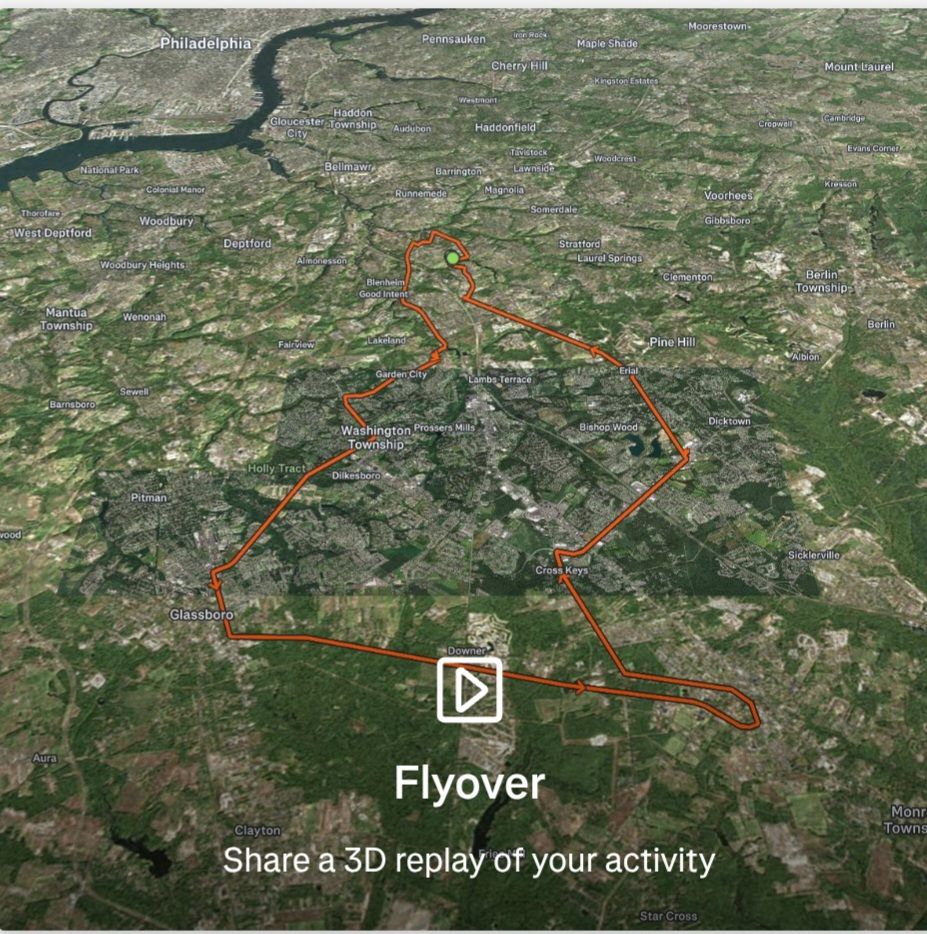
Saturday, August 30 was my first longer ride after turning 65. I was looking at a map and noticed a bike trail from Glassboro to Monroe Township here in New Jersey. So I planned a route from home in Blackwood that went down the Gloucester Township trail trail. From there i went to Washington Township, and from there to Glassboro. Taking a left, i was on the paved trail, which is wide enough for multiple riders. Along the way, I met a police officer diving his car on the trail. This officer was friendly and polite, and it gave me a good feeling to note that this trail, with most of it through wooded areas, was regularly patrolled. The trail has a number of benches and trash cans, which makes for nice places to stop for a snack and keeping the trail clean.
I apologize for having been away for a time. As you, my readers, can imagine, writing a very personal blog requires something of a person that mere commentary does not. At the same time, recovery from cult trauma is neither linear nor predictable; one day things can seem fine, and the next you’re that little girl again, hiding, afraid, because if anybody sees you there will be another beating, more repercussions from the church.
That all being said, there is news. I will be back in my writing saddle, and I’m working on a cult education project for which more details shall be forthcoming. There may also be a video series in the future – again, more about that as it develops.
But my spirituality has been on its own journey, with insights about trust and my own relationship with God, who I am, who I’ve been, and so much more. I’ve come to understand how much was stolen from me by the church – the cult of my youth, and I stull struggle with self-acceptance and trust because of this. These are questions that will be more of the focus of upcoming posts, along with the requisite poetry, and possibly even videos. So, please stay tuned!
I am nobody’s Daughter Born of blood, born of water Not respected but rejected I became nobody’s Daughter
I became nobody’s Daughter Fighting through mud and blood and water For the right to be for the right to be me I became nobody’s daughter
I am nobody’s daughter With a heart full of love that is stronger than blood With a heart full of love that is stronger than water. Pity those who made me Nobody’s daughter
Each year, Friends from Burlington, Haddonfield, and Salem Quarterly Meetings, and beyond, gather together at camp Ockanickon in Medford, New Jersey, as they have done for generations. It’s a time of recreation, spiritual rejuvenation, for meeting old friends, and making new ones.
Tri Quarter 2016
If you grew up Christian, you might have been to retreats; this gathering was something like that. If you went to summer camp, this gathering was something like that too. If you can imagine the best weekend possible with family and friends, old and new, that’s what this weekend was, along with healthy time to encounter self. I’d say it was a perfect weekend, but that would be an exaggeration.
Are Quakers perfect people? By no means! I’m no fan of Paul, and I think that is all of the writers in the Bible his words have caused great harm, but I do agree with what he said in Romans 3;23 “for all have sinned and fall short of the glory of God“
Quakers aren’t perfect, but there is one thing that we practice regularly. We practice listening. We try to hear the voice of God. And some of us try to hear that voice of God in the voice of others, knowing that “there is that of God in each of us”. And when there is a gathering of believers joining together for collective recreation, learning, and worship, something special is bound to happen. And it did, as it apparently does reach and every year.
When I began this blog I wanted to be able to post daily. What I’ve found is that while I can write daily, I am not able to fully explore my thoughts, particularly on certain subjects, in a way that let’s me complete a well thought out post in that short amount of time.
I could use writing prompts thst are relatively meaningless to me, (today’s is “do you see yourself as a leader?”), but I don’t think that people reading this blog are looking for answers to canned questions. On the other hand, if you do have questions for me, fire away!
When I was little I used to wonder what it would be like to have amnesia. I wondered how somebody could remember how to talk, how to eat, how to drive a car, but not know who they were. This went on until I was diagnosed with and began to understand Dissociative Identity Disorder and Complex PTSD.
I no longer need to wonder what amnesia is like because I realize I’ve been living with it for most of my life. As a child it sometimes got me into trouble. I would be advised of doing things I had no memory of doing, I would find myself in places and not know why I was there, and there would be blocks of time that would go missing. But when you grow up like this, you don’t recognize it as out of the ordinary, and when you see portrayals of amnesia on television, they are always seem as very distressing. I had no reason to believe what I was experiencing was anything out of the ordinary.
Our minds are extraordinary tools. For the most part, we all experience some amount of healthy amnesia; those rare individuals who can experience total recall can find it burdensome. The fact that we are able to relieve ourselves of the burden of hanging on to unnecessary memories and information makes our lives easier and makes it easier to access important information, it helps to keep our minds from being cluttered.
I Will Remember You
When I first came to understand my own amnesia, and to understand that with dissociative identity Disorder that I had been interacting with the world as more than one person, it was troubling. Therapists tried to help me by telling me that these ‘alters’, other aspects of myself, had formed to help me deal with traumatic events. But one day when I was looking through a box of old getting cards I found some things that hurt me. There were cards, addressed to me, from people whose weddings I had written music for, played at, people thanking me for my friendship, and I didn’t know who they were. I’ve had people tell me that I was known by a completely different name in a nearby city.
What I know today is that my childhood wonder about amnesia was perhaps naïvely prescient; I was curious about something that has been affecting me all along. And the interesting part with traumatic amnesia is that the memories aren’t really gone – they are just, to use computer lingo, in hidden folders, or inaccessible to certain users, or sometimes simply in the wrong folder.
When we have flashbacks, even if we don’t normally have access to those memories, something in our environment can trigger a link, open that folder, find that traumatic memory and hit “Run”, often with “repeat” enabled.
I think the word “triggered” is often overused lately. We hear it for anything that upsets someone. For those of us with PTSD, it’s something more than simply upsetting. When we trivialize the word ‘trigger’, we also trivialize the idea of trigger and content warnings. These aren’t there simply to prevent somebody from feeling bad; they exist so that people will be able to continue to function.
There was a time some years ago when I was triggered by an article I read. It affected me for days. It affected my ability te work, to sleep, to drive… I could be driving and see not the road, but the living room of an apartment in 1977 in Dover, NH, and I was just as much there as I was behind the wheel of my car driving to work.
Fortunately, we do have told to deal with trauma. There are therapists who deal with trauma, there are therapies that are effective. Nothing, of course, can erase the trauma; that’s effectively what amnesia tried to do for some of us. But we can learn to live with it. And one of the most important things I’ve been finding is to have good relationships, and to find a way to live a fulfilling life.
Sometimes finding people who love and accept you, especially if that was lacking in childhood, can be a double-edged sword. When you find these people, you begin to understand what you were missing. And it can hurt. Allot. But it matters so much. And it’s healing like nothing else can be. And healing is the point.
The best to of all, along with therapy, is to fill our present with good memories. They may not replace the bad ones, but perhaps we can overcome the bad ones with both quality and quantity.
When I was young I thought I had friends. I certainly has people who I was fond of, but retrospectively I realize that I never had actual friends. When I was young, and until I was about forty years old, I was playing roles – I was trying to be who my parents wanted me to be, who my church wanted me to be, but that wasn’t me. While I had people who liked who I was, they were in a sense being cheated because the person they knew was a fiction.
Friendship, true friendship happens when we have the ability to show others who we are. The unspoken challenge in this is the ability to be honest with ourselves about who we are.
For most of us, when we’re growing up, we have friends who help us discover ourselves. We can try out versions of who we are. Friends help us by giving feedback, letting us try things out, helping us to discover who we are and who we wish to be.
In cults things work a bit differently. Cults tend to eschew individuality. Individuality involves people thinking for themselves, and that individual thought can be a wrecking ball to a cult’s ability to control am individual. While there are core parts of our identities that will remain, the goal of cult leaders is to keep members so engaged, confused, worn out, or indoctrinated that the core part of who we are is always overshadowed by the cult persona. But that core part remains, and this may be one reason why so many friendships and marriages that were entered into while people were involved in a cult endure after they escape. That, and of course the shared bond of surviving a difficult time.
When people leave cults out offten takes time for them to discover, or rediscover their own identities. When you join a cult, the cult works hard to replace your personality with a cult personality. Think of the folks in orange robes decades ago that you might have seen in airports. Think of Mormon missionaries and how they dress the same, smile the same, talk nearly the same. It really is much like society in the book and film The Giver.
On leaving a cult, one doesn’t automatically rid oneself of the years of decades of programming it took to bring about that uniformity. And for those of us who were raised in cults, and never had an opportunity to find out own individuality as children, the task is exponentially more difficult.
But at some time in each of our livesI hope we all come to a point where we are ready to be honest about who we are. We decide to throw caution to the wind and show ourselves – warts and all.
It’s when we can trust someone else enough to share who we are with them, and more than that, when we can trust ourselves enough to be able to do so, that we have found true and honest friendship. In my case, my closest friends are my family. I know that I can trust them. I know they will be there – in ways my own family could never have been there for me. I know I’m loved, and my love is accepted in return.
When I call someone “friend”, it’s not something casual, it’s not a euphemism, or a synonym for acquaintance. It’s a commitment, and a bond as strong as I wish my own family’s bond could have been with me. My friends are my family.
To me, the saddest possible words are “she’s just a friend”. To me, someone who chooses to love is every bit as important as one who is compelled to do so because of genetics.
In tuesday’s post I mentioned something I learned while in a residential trauma program for women. This took place at McLean Hospital in Belmont, MA. This trauma program was a turning point (one of many) in my healing journey. While there, my diagnosis of Dissociative Identity Disorder was confirmed, and I will talk about that in some posts. I also became ready to face some of the trauma of my childhood.
Before this stay I had at least eight psychiatric hospitalizations, and I had seen numerous therapists, but I hadn’t been ready to truly face the trauma that had happened to me.
What I did know was that I wanted to be loved and accepted by my parents but that had always seemed unattainable. Still I tried, and tried, and tried. Then, during a workshop, I recall one of the facilitators say that “Love is not a sufficient reason to remain in a destructive relationship.” When I heard this, I immediately recognized many in my birth family as destructive relationships. I was certainly not a full and equal part of the family; for starters, I am intersex and for some reason, my parents and two of my brothers view this as a choice rather than a genetic fact. They see me as morally weak and spiritually deficient, and not as someone who was born with a rare set of genetic mutations.
When I was younger I had once told my parents that I didn’t want to live as a male, but their response was a threat to institutionalize me in the state mental hospital. This has happened to an uncle years prior, and while I was never told the reason he was sent there, the career of a brilliant young MSN was destroyed. My uncle has been a local celebrity as an artist, and had been gifted academically. By the time he left the hospital years later, he couldn’t play board games.
Even after this, I still tried to forge a closer bond with my family, but it was to no avail. As a child, I had been forced to live as male, and I had made it a practice to perform music at family events such as weddings and funerals. This continued for a time after i decided to live in a way that better aligned with my own identity, as a woman, but it caused a riff between me and my family.
When I Was A Boy
It became increasingly clear that most of my family didn’t want ‘me’ there; they wanted their idea of me – they wanted who they wanted me to be rather than who I was. It became clear when I was prevented from singing at my Godmother’s funeral. It became most clear when my mom passed away and I wasn’t granted the privilege of being referred to by my own name in her obituary, with my family instead choosing to use a name for me that hadn’t been my legal name, let alone my chosen name, for decades. What was absolutely clear was that if I couldn’t be a son or brother, I wasn’t welcome. It didn’t matter that I am who I am because of a genetic condition. What matters is their beliefs about the situation. And an intersex daughter or sister isn’t part of the equation. The choice became one of harming myself to be accepted by my family, or finding another way. I chose the other way. I remembered the words of that counselor, and while I love my family, the price of being with them is too high.
Some stories aren’t as dramatic as mine, others are much more dramatic. We exist on a spectrum. Each story though, it’s equally valid – yours is a valid as mine. So you have relationships that are costing you more than they should? What steps can you take to make them more equitable?
And remember, while that counselor said that love isn’t a succubus reason, she didn’t say there were no other reasons.
 Morning Musings