I’m a Quaker, and most of the time, I ride my bicycle to meeting. Today, when I got up, it was raining, and while I could have taken a bus or found some other means to get there, I rode my bike.
Riding usually helps me clear my mind. Even when politicians are bent on harming or eliminating swathes of our population, even with economic uncertainty, riding can often help me to clear my mind.
Today, my mind has been troubled. As a Quaker, I believe that there is that of God in each of us – some spark of human divinity or divine humanity that is able to enlighten every single person on Earth. But I am also intersex, and because I’m not living in the gender that I was assigned at birth, I’m also trans. And living under a regime that considers me a terrorist simply for that, I have difficulty seeing that divine humanity in some people.
Still, I’m a Quaker. It’s not up to me to ignore that spark of the divine in those who would wish harm upon me. Instead, I need to recognize the wounds that render such people incapable of finding that of God within themselves.
The human part of me can lead to dark places. I can be led down a road of anger, resentment, or even self-harm. But there is that spark that lives in me that will, when I listen to it, when I give it the fuel it deserves, when I provide it kindling and let it burn within me, show me another way.
In the rain, I can take what many see as unpleasant, and i can let it wash and cleanse me. I can ride and clear my mind.
A friend once wrote of the rain, saying, “Me, I’m not alone. I have the rain. I have my soul set free. ” And I suppose that’s a lesson for me. Rain can upset some people. It can stop some of us in our tracks. But, at least for today, it washed me; it was my friend.
And that, sometimes, is where riding in the rain leads me.
I’m sorry for being away for a while – we sometimes become busy, take on other interests – life changes. And perhaps that’s what I’ll talk about, in a way, today.
I’ve been riding my bike this summer, a lot. In the past few months, I’ve ridden more than 1,000 miles. It’s how I commute to work, to Quaker meeting, and it’s how I’ve been exploring the local area. I’ve seen some lovely things.
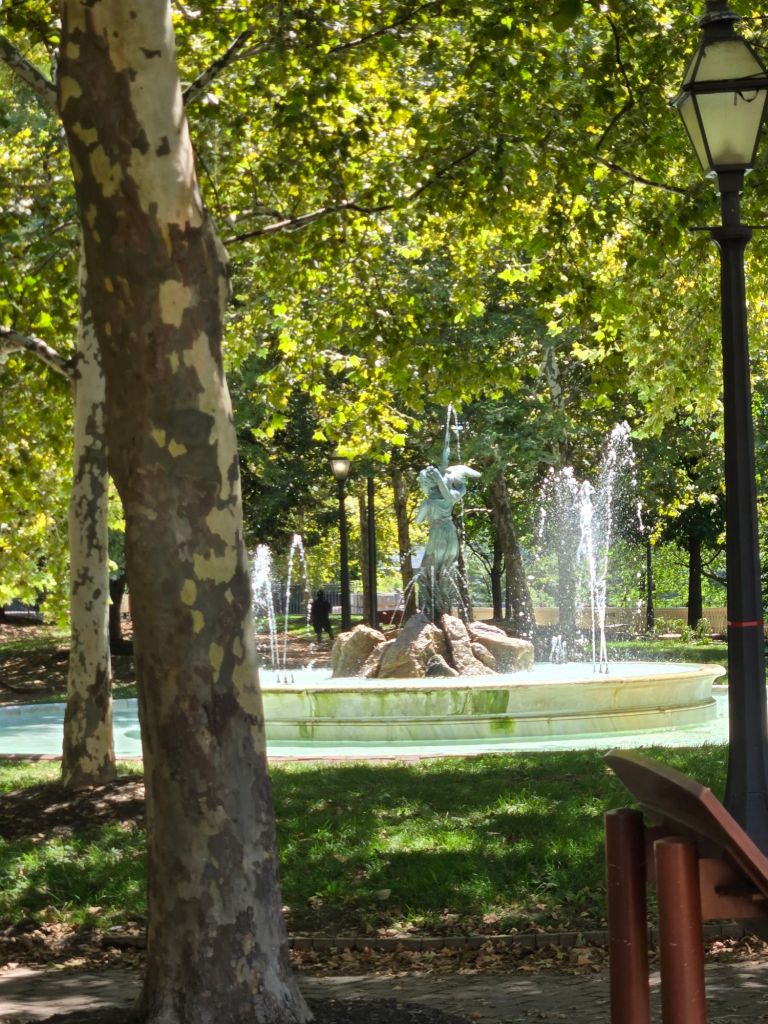
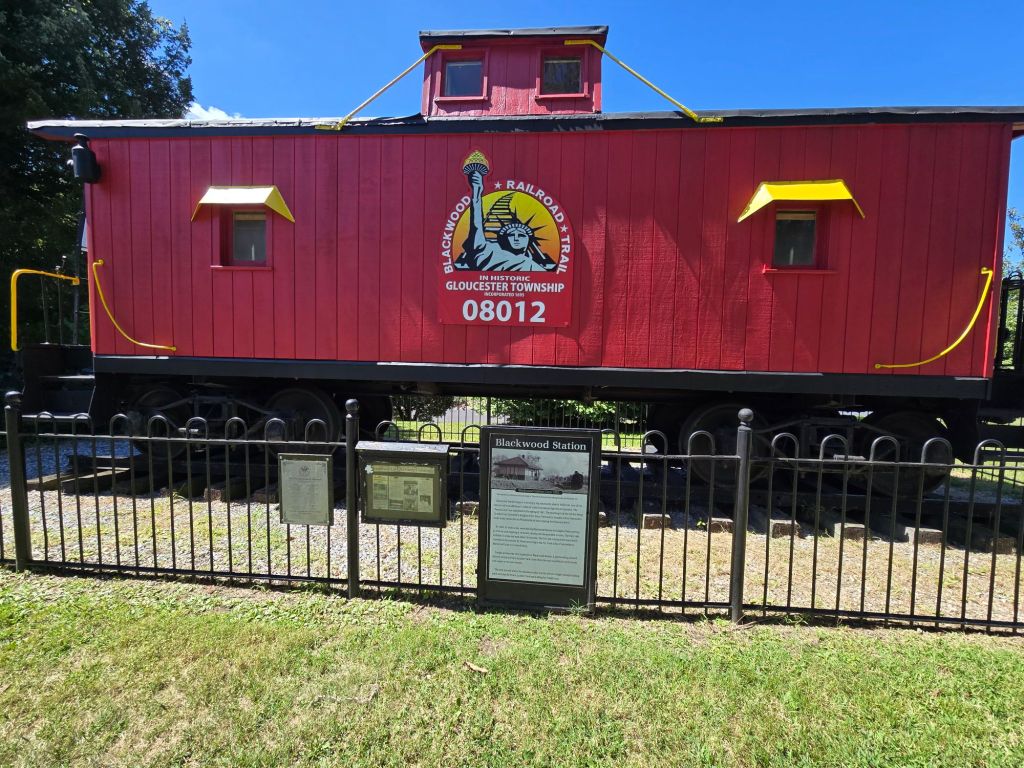
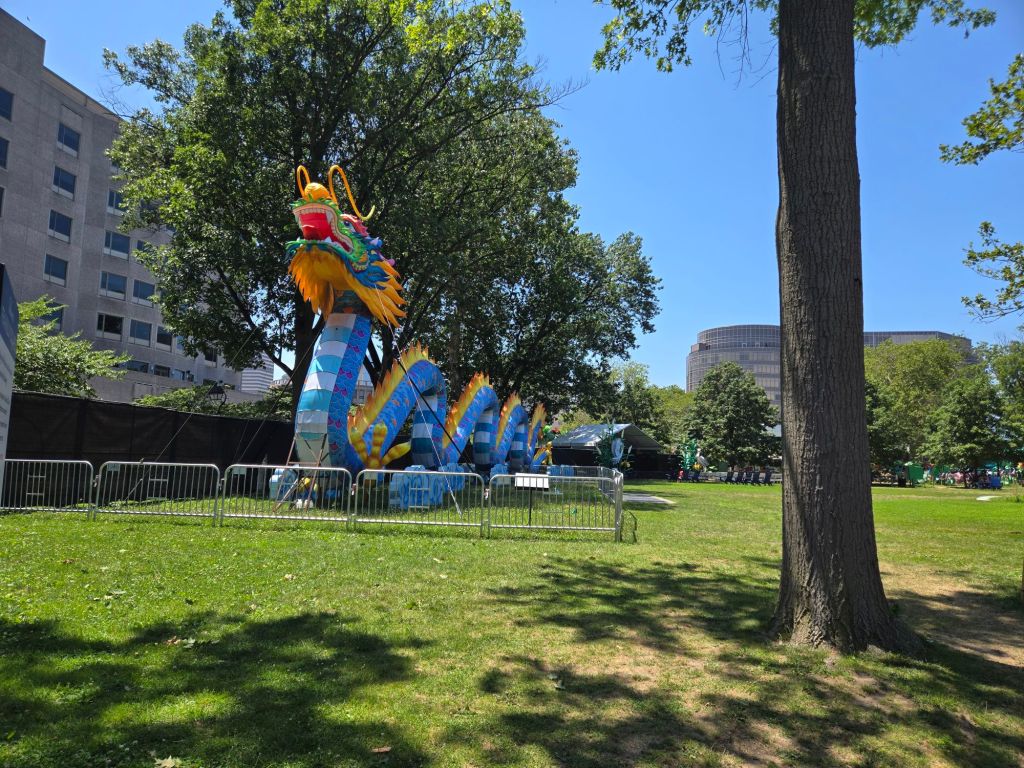
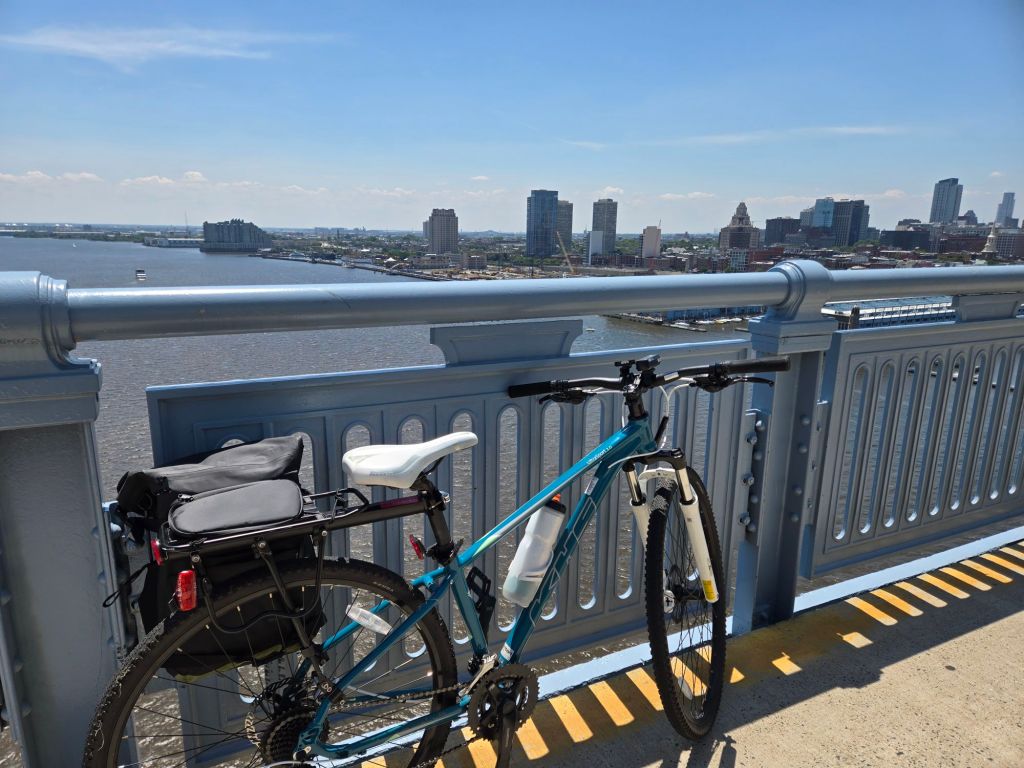
Playful angelsPhiladelphia skylineBust / statue of Frederick Graff. PhiladelphiaFountainCaboose on Gloucester Township trailSculpture in Cherry Hill NJFranklin Square Philadelphia – lantern festivalLantern festival – PhiladelphiaBen Franklin Bridge, Delaware River, Philadelphia skyline, and my bike.
But riding a bicycle for long distances isn’t easy. Hills aren’t easy. Riding into a headwind isn’t easy. But it can start to feel easy-er. Still, that hill you’ve ridden over 100 times isn’t less difficult than it was the very first time. It takes exactly the same amount of energy as it did the first time; assuming you haven’t lost weight or got a lighter bicycle. Without such a change, that hill is just as high and pedaling the same weight over it takes the same amount of energy – it’s the same amount of work. What does change is our ability to perform that work comfortably. It feels easier because we have become stronger and more adept.
And that’s the life lesson, it seems; the more we get out and do the things that are difficult for us, the more capacity we build to do those difficult things.
I recall one day pedaling to work when a lady pulled up in the lane to my right. She commented on the strength of my legs and how easily I had just climbed a hill. I wanted to tell her that the hill was definitely not easy, but the light changed, and we went different ways. And that was when it struck me that I was making it up that hill faster than I used to. And perhaps after 1,000+ miles, i’m no longer a beginner, but hills are still a challenge. I’m just in a better shape to be able to tackle them. And it’s really no different for other difficult things in life. It’s all about growth. Growing in strength, growing in faith, growing in compassion, growing in trust. When we exercise what we have, it becomes easier to put to use.
Everyone feels out of place once in a while; sometimes we feel out of our depth, like we don’t belong among people we hold in high esteem, or simply unsure where we fit in a new employment situation. Perhaps we are a new girlfriend or boyfriend meeting a family; there are lots of situations where we might find ourselves just a bit adrift.
For those of us who were raised in cults (or other sorts of high demand, abusive, or narcissistic environments), finding our way as adults is a fraught endeavor. Where others seem at ease and comfortable, we struggle. Where others seem energized and enjoying conversation, we are guarded and measured and constantly gauging ourselves.
On the other hand, if we find ourselves in a tightly controlled environment with strict rules, like military basic training, a strict martial arts class or other situations that might stress out more “normal” people, we tend to thrive. Give us strict rules, dress codes, a well-understood hierarchy, we’re ready; this is our comfort zone. Ambiguity, on the other hand, leaves us unmoored, untethered, adrift.
If one were to read the literature regarding treatment of survivors of cult and religious trauma, a number of common themes would recur; other than ptsd and depression, many of us deal with dissociative disorders. We often find it difficult to be present, to experience our own lives fully as individuals. Some of us have had incredible difficulty even discerning who we were outside of the group, or outside of other relationships, never having had the freedom to form our own identities as children.
It’s little wonder then that as adults we struggle when trying to find our own place in what seems a tumultuous and confusing world. Too, it can be dangerous as survivors when we find groups that are too welcoming or too friendly; some of us will be overly suspicious and avoid an entirely benevolent group whist others might jump in only to be once again ensnared by someone with devious intent. It seems that survivors are often stuck in one of two modes of interaction; we can be too trusting, or too suspicious. Sometimes we can exist in a strange amalgam of both.
I suppose that my goal has been to find my own way out of this mire. I’ve often wondered what it is within me that is lacking, but the wonder has been window-dressing only. I know what has been lacking. The lack was the ability to trust in somebody who was trustworthy when I was young.
In a functional family, a child learns to trust her parents. She learns that if something is wrong, he parents will do what they can to fix it. In cults and other abusive relationships that trust bond is never created. Survivors don’t properly learn who to trust. We might have been taught to trust people who abused us, we might have had serious medical conditions but were told that we were malingering, or that it was all in our head. We were taught not to trust ourselves, not to trust what our own bodies were feeling, and not to trust our own intuition. We never had the opportunity to bond with a trustworthy individual in whom we could legitimately place our trust, and therefore we developed no legitimate mental image for trustworthiness. What is intuitive for many is theoretical for us. To use an analogy, if one grows up catching baseballs, it’s not overly difficult. But if you approach it from the viewpoint of computing arcs and proper coordinates to intercept the ball, a runner will be around the bases before the short- stop ever gets a ball to first base. If one grows up with a healthy understanding of trust and trustworthiness, this comes easy. But when this is learned later in life, it’s not so organic; there are extra steps.
So what to do?
The first trick is to rewrite the troubled instructions from childhood. We can let the little girl who was not able to trust know that there are trustworthy people in the world and we can help her to learn to trust the right people. We can let her explore the world and learn the difference between trustworthy people and those who are not. This might come about through friendships, with a therapist, or others who are genuinely trustworthy.
Some are now stating an obvious question and pointing to a possible hole in my plan; how are we to find a trustworthy person in the first place? I was fortunate in finding friends who had no agenda for me. I suppose that it’s much easier said than done to suggest someone else find the same, but there are also cult survivor support groups and experienced therapists who will put your needs first.
Once that little girl is able to begin to develop an intuitive understanding of trustworthiness, things will begin to change. In my life I’ve noticed a shift in thinking when I met people; it used to be that I’d be intensely concerned about angering people – i’d be looking for clues regarding appropriate behavior or conversation topics. Being myself was something alien to me.
I recall one conversation where a dear friend introduced me to someone she knew and this man spent more than a few minutes talking to me, interested in what I was doing. I was terrified; not of this man, but of making my friend look bad because she might be associated with someone like me. When I addressed my concern with this friend she was upset, but not for any reason I could have expected at the time. Where I saw myself as a nobody and the man that she introduced me to as a successful radio executive (or something of the sort), my friend saw two people that she cared for, neither of whom are nobodys.
My job has been to break the childhood programming of being a nobody, a little girl, damned and unworthy of protection, and understanding that that little girl wasn’t a nobody. That little girl was somebody worthy of love and protection, and so is the woman she became. And understanding that I am worthy of love and protection vines me permission to trust and to judge the trustworthiness of those who come into my life.
I can now act with agency. I can meet people and be myself because I can say what “I want” instead of what some church told me that I was supposed to want. I can be who I want to be. I can love the things and the people I choose to love. I can have real conversations about real aspirations rather than fabricated ones; about accomplishment that I’m truly proud of, about people I love and have loved.
First leaving a cult leaves one dazed and confused for a long time. That confusion will periodically return because we don’t live in the same world that we grew up in; the cult reality and actual reality aren’t the same thing at all. But got those of us who have dealt with the trauma, through therapy, support groups, exit counseling, after a few moments of reorientation, we can for once be truly ourselves.
When Jesus uttered these words he likely shocked his followers – certainly the proper order was for children to emulate adults, and not the other way around. Adults were the teachers, children were to learn, and to upset that order shouldn’t be done.
Just like a Child
In his book Spotting the Sacred, Bruce Main speaks of being childlike, but he points out one quality that has always meant a great deal to me in chapter 5 when he speaks of “unrehearsed congruence”. In the section where this term is used he is referencing the spontaneous prayer of a child and its effect on a man who heard that prayer.
I have in my own life often wished that I could find that spontaneity. Growing up, spontaneity and improvisation were things I could ill afford lest I show too much of myself. Being myself instead of who I was permitted to be resulted in harsh punishment. I learned to be aware and in control of what I said, how I moved, who I was with, simply so I could avoid beatings or other punishments. What I lost was spontaneity and authenticity. I managed to hold on to my curiosity, but it needed to be restrained to areas that were”acceptable”.
I also avoided children; not because I didn’t like children, but because I was told that people like me – people who struggled to simply be who they were told to be, would grow up to be the sort of people who would abuse children. Even around my own daughters, finding spontaneity was not possible. The fact that the individual who told me this was a serial abuser should have meant something. But in avoiding children, I lost something that has taken me many years to rediscover.
At the same time, being raised in a controlling and abusive environment, and finding recovery afterward has taught me something important; resiliency isn’t something that need be lost forever.
I found that one enemy of resiliency is resignation, while the path to resiliency, and to the Kingdom, as Jesus put it, is to “become like a child”. In my own case, that path involved the most child-like act of finding a friend; of being open to a relationship, of trusting.
For survivors of trauma, trust can be a dangerous word. For many of us, often as children, our trust was, in many cases, betrayed. We are not given as adults to trust easily; it is something we must re-learn. We must “become as children”, not entirely, but at least in part.
I have also found that in “becoming like a child”, at least in learning to trust, I have also learned to feel more deeply. I can feel joy, sorrow, and especially love much more deeply and viscerally than I could before. When I had put aside not childish, but childlike things, I had also walled myself off from being hurt. After all, big girls aren’t supposed to cry over little things, or things that are long past; at least not if we’re “emotionally stable”. But being childlike is a recognition that the “rules” of adulthood, especially our Western, puritanical, capitalist, ‘drag yourself up and get on with it’ attitudes, are mostly bullshit, and terribly harmful to the human condition. Rather than helping us heal and move on, these attitudes leave us with emotionally disfiguring scars and festering wounds as we seek to navigate life pretending that all is well and that we need no help or compassion.
In ‘becoming like a child’, we’re able to reach out when we need help and when we see another in need. We discover, at once, compassion and resiliency because they are both sides of the same coin.
Real healing looks different. Those who heal still carry reminders of past trauma, but it doesn’t leave them broken and disfigured with wide-open wounds. Instead, the stories of past trauma are woven into a rich and colorful tapestry that radiates strength and hope and which is a celebration of life. This isn’t to say that one must experience trauma in order to fully experience life; rather, I’m saying that those who have found a path to healing learn to integrate their previous experiences, even the traumatic ones, into the fabric of their being in such a way as to make that resulting tapestry more beautiful, richer, and stronger that it otherwise would have been.
We need to understand too what real compassion looks like. This is another part of us that has been harmed with our modern, puritanically and capitalistically influenced way of thinking. Too often when we hear of another’s problems we are quick to offer advice or solutions and forget that what many really need, especially early in their struggles, is to simply be heard and understood. When someone is facing, for example, a life altering medical diagnosis, they will certainly hear from many about the benefits of CBD, herbal remedies, and countless people who recommend some specialty treatment. Often though, what someone really needs is someone to simply hear them and to give them the space to come to terms with the change that is taking place in their life. What they need is a compassionate listener. What they need is a friend who will simply be there.
As children, there were many times when our friends could not solve our problems and we could not solve theirs. Often enough, our problems were their problems too. But those problems became easier to bear because those friends were their. When we can regain that childhood trust in each other and make each other’s lives easier, we are discovering part of what it means to “become like a child”.
Recently I was occasioned to take part in an extra-judicial proceeding that dealt with some abuse I experienced as a child. Alone, the experience would have been much more than would have been bearable in a healthy fashion. But I asked my best friend if she would be with me, and she went. What might have been a terribly stressful experience became instead something that was also healing, despite it’s nature, for both of us because the experience was shared. It brought us closer; we learned more about ourselves and about each other.
Perhaps that’s yet another part of both being childlike and resilient – being able to continue to grow and heal, to recognize our weaknesses, to know that there is yet much we can’t do alone. Sometimes we need to be content to wait and find what peace and joy we can in the here and now, despite what seemingly integrate things may otherwise be happening. Earlier in the book of Matthew, Jesus gave his familiar parable of the lilies of the field which neither spin nor sow, yet are dressed in more splendor than Solomon himself. They don’t toil, but God provides for them. Jesus’ point was not that one shouldn’t ever work, but rather that work and effort extended solely for the purpose of vanity was unnecessary. When we look at young children, we don’t see them worried about how they or their friends look; instead, what matters is the quality of the friendships they make, whether they play well together, whether they share, whether they care.
It’s only as we become older that physical beauty begins to take on as much, or in some cases more importance than inner beauty. It seems that we are taught to find distasteful those who do not conform to a particular aesthetic. We can become more like children by worrying less about physical appearance – our own as well as that of others, and more about character – especially our own.
Children are thirsty for knowledge. They are naturally curious about everything. They aren’t satisfied with “just because”, nor should we be. It may seem more grown up to not ask “why”, but perhaps that’s one reason we’re in such a mess right now. Maybe we need to ask “why” more. Why can’t we have something like a National Health Service in the US? Why do we need to rely so heavily on oil and the resulting pollutants? Why can’t we have clean air and water? Why can’t we have equal rights for all? Why must we fear that the rights we do have will be stripped away?
The difference we have was adults is that along with our childlike questioning, we also have adult autonomy. We can change our world, and we can change ourselves. While we may not be able to change our past, we can still correct the deficiencies we may have had in our upbringing. If there were things we didn’t learn, we can still learn them. If we were lacking the love of a family, we can yet find even that – this I can promise you because it happened in my own life.
What I can say about my life is that every truly good thing that happened to me began when I had trust, like that of a child.
After work yesterday I decided to walk to the pharmacy. It’s about 2 miles, but it would connect connect two areas where I’ve done allot of walking. (I keep track of the routes I walk or bicycle and highlight them on maps – it’s just a strange thing I do.)
Lately though, I’ve been finding things on my walks. One day it was $5.00, on another a dollar. One day I found a WW2 era Japanese bayonet still in serviceable condition, with just a tiny amount of surface rust on the blade that was easily cleaned away. It is strange the things one can find, and strange the things that can come into our lives when we have our eyes and our hearts open.
On the walk last night as I was walking from Woodcrest to Ellisburg in Cherry Hill, it should have come as no surprise when I found something interesting on this walk, but this item was unique. Some would argue thst finding a WW2 Japanese bayonet on a street corner in Camden NJ is unique, so I guess that what we are discussing is degrees of uniqueness. But as I was walking on Brace toward Ellisburg I saw a strangely colored object moving on the pavement. When I got to it, I picked it up and recognized that it was a Hermit Crab, and knew that it wouldn’t be able to get up the curb and off the road, so I set it on the grass and walked away.
Then I began to think about a Hermit Crab surviving in the wild with winter approaching – they are tropical creatures. How long has it been since it had food or water? But if I picked it up, what could I safely carry it in? So I had a small nylon bag for my raincoat that I keep in my backpack and I placed the little creature in there and continued my walk – I was going to the pharmacy to pick up some prescription refills, and I was trying to figure out what to feed this tiny creature, as well as how to house it. I didn’t have hermit crab food, and wasn’t near a pet store, and the pharmacy pet section didn’t have anything for hermit crabs. But they did have some dog treats that were made of seafood, chicken, and vegetables. They had a covered aluminum lasagne pan, and some spring water. I purchased those and made my way home. Hermie proved to be an adept climber and nearly climbed out of the bag before I noticed, and on part of the walk home it had got very chilly so I held Hermie close. (Since Hermit crabs can change sex whenever they molt I’ll use gender neutral pronouns borrowed from Marge Piercy here of ‘hir’ and ‘hse’.) Hse seemed to appreciate the warmth of my hand and body in the chill of the night air as Hse was able to remain much calmer.
When
So we made it home though, that calmness abated, or rather, hire unsettled nature was revived. I put hir in the lasagne pan with some small decorative stones and a bowl with water, and placed some of the dog treats inside for food. Hse was quite active until finding the food, and really remained calm through the night. I ordered a habitat with a heater and proper food to insure Hse gets the needed calcium and other nutrients, and shall get a playmate too.
I did post that I found this little one on my Facebook page and on Nextdoor, and if a child lost this little one, I hope we can connect, but I honestly find that unlikely and more than a little sad. So the best I can do is to give this one a home and treat it well and think that perhaps there was some reason that I chose that day to take that particular walk. Maybe the universe isn’t entirely random after all.
So now I’m done my day and heading home from work. I’m looking forward to seeing Hermie and how he’s doing, offering another snack, seeing if hse likes to be held, and hope to offer it a good home while it’s here.
I never saw myself as an adopter of hermit crabs, but then again there are many things I never saw happening in my life. Life gives us what it will. Our choice is what to do with what we are given.
It was Saturday around noon and my roommate noticed a praying mantis (a brown one) hanging out above the shade over the patio sliding door. I tried to get it to climb on my hand to get it outside but it was really reluctant to do that so we got a soup bowl and a bit of cardboard and I captured it and took it outside to a small garden. When I took the cardboard of the bowl the mantis immediately climbed on my hand and started climbing up my arm. It was really fun to see this creature that was so fearful moments ago now becoming gregarious, but I had to keep it from getting tangled in my hair.
I blocked it’s path with my other hand and put my arm close to the ground. (Brown mantises are ground-dwelling, which is why their camouflage is brown instead of green.) The creature then strolled of my arm in to the ground and made it’s way too a more natural habitat.
This has me thinking of a parallel in my own life. The mantis didn’t want to leave our house – it was content where it was. But had it remained there, it would have not found sustenance; it would have starved.
When I was living in New Hampshire, I was not being fed spiritually or emotionally, and I didn’t have an opportunity to perform my my music, and I wasn’t writing. I was stuck, I was starving.
There was a time in my life when I was very depressed – multiple times actually, but during one of these times this song, Secret of the Crossroads Devil by Gaia Consort became incredibly important to me. Christopher Bingham is a brilliant songwriter and a musician whose skill I can only dream of possessing, and this song simply spoke to my soul. The line “If you want to read the mystic story written in your future, you better start to write it now” meant a great deal to me, and I did manage to begin that writing. I opened up to some friends, I began understanding myself, I got myself into a 2 week residential trauma program for women. Things were changing.
But it was just over 2-1/2 years ago that I did for myself what I did for that praying mantis today. I took myself out of an environment that wasn’t sustaining me and moved myself to a place that was better able to do so.
Sometimes, I think, we all need to find that special place that sustains us. Are you being sustained where you are? Or are you like that praying mantis in need of relocation? Perhaps you don’t need as drastic a move as I made, maybe it’s a new job, a new hobby, or maybe you can explore some new genres of film it music or reading. Maybe you have some as-yet unresolved issues that a therapist might be able to help you with, it perhaps you’ve been putting off some medical tests or a physical. Change isn’t easy. Like the Praying Mantis, we don’t always approach it willingly. But often enough, it’s exactly what we need.








 Morning Musings